
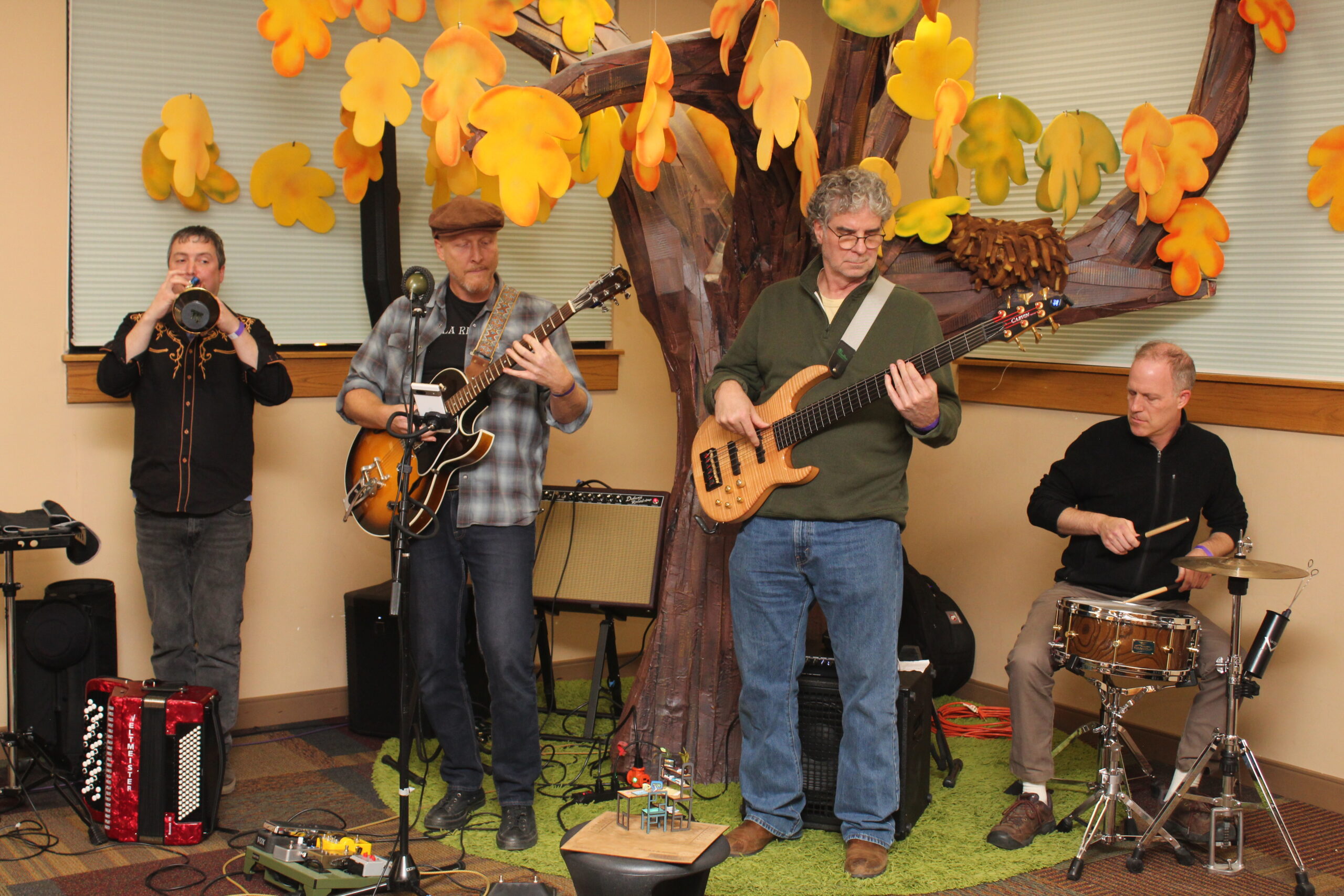
The quiet room on the second floor of a mountain community’s public library is an unlikely place to attend a punk rock concert, and yet that is exactly what occurred during Estes Valley Library’s after-hours Tracks & Stacks event last year. In fact, the library hosted six bands or musicians during a single evening culminating in a community experience not unlike that of a music festival. Not only did the event bring in over 120 people (both regular library users and new faces), it was also a prime example of how a library can build community and bring joy to those it serves whether they’re avid readers or not.
With that being said, I’m sure there are library staff who might struggle to see how hosting an event of this scale is feasible and wondering what (or who) inspired the idea in the first place. I had the same questions when first hearing about this event in my search for Colorful Colorado Libraries. By sharing stories from the people who made it happen, this first post in the Colorful Colorado Libraries blog series will illuminate what took place behind the scenes (or in this case back stage) to bring this event to life.
Setting the Stage
This event was not the brainchild of a library staff member but of an Estes Valley community member, Jason Lenz, who approached the library with a plan. Polly Gallagher, from Colorado State Library’s Library Development office, and I had the opportunity to speak with Jason and hear how he came up with the idea as well as how he collaborated with the library to make it happen:
So it starts out on a slow work day. I’m dreaming of being a full-time musician and just getting more gigs. And so during this day, I check my phone here and there, and I get this notification from YouTube that there’s a new NPR Tiny Desk concert just available. . . So it starts with that, and then watching the set behind them. They have all of these little figurines, little sculptures, arts, but it’s all on a big stack of books. And so you see that same stack of books over and over and over, and it’s just misinterpreted, like, this could be at a library. . . and I was thinking, “Okay, well, let’s maybe try doing it as a local thing. I wonder if a local library would host this.” And I was thinking of our library here in Estes Park.
After one of NPR’s Tiny Desk concerts inspired the idea for Tracks & Stacks, Jason didn’t race over to the local library immediately to share it but instead began putting feelers out into the community to gauge interest and working strategically on a pitch that would appeal to the library:
So it became this big idea that I would talk [about] at the brewery that I worked at, just talk with people that I knew were in the library as either a volunteer or a worker. And every person was saying, like, “Wow, this is actually a good idea. You should do this.” So I was like, “Okay, let’s start thinking of serious ideas to really make this a thing, and how can I do this?”
The idea for Tracks & Stacks grew and grew until, about a year and a half later, Jason contacted the library with his proposal. Estes Valley Library did not immediately jump on board, but Jason had prepared for this to take a little persuading and even built a PowerPoint to accompany his pitch. In the end, it still took a little encouragement from a friend telling him, “This is too good of an idea. You have to push forth and be uncomfortable in your situation and try to get your idea across,” to persuade Jason to ask to meet in person to present his idea. Then, it took an open-minded library staff member to want to listen: “Shari is the one who made this happen. She’s the one that said, ‘Yeah,’” Jason explained to us.
Shari Baze, the Technology Arts Librarian at Estes Valley Library, also generously agreed to speak with us about how the Tracks & Stacks event came to be. When asked about her initial reaction to the idea, Shari said:
I was like, “Oh, that sounds really interesting. That sounds like an exciting project.”. . . I had a little bit of trepidation because it was like my first big, big library event. But overall I was really excited just at the collaboration and bringing something different to the library.
And so, just like that, Shari and Jason decided to turn this idea into reality.
Coordinating Logistics
Shari knew from the start that there would be “a lot of moving pieces” to this event. True to the inspiration for the event, NPR’s Tiny Desk Contest, a main component and motivation for bands or musicians to participate was having a video of their performance that met the criteria for Tiny Desk submissions, which requires musicians to submit a short video of themselves performing a song, and the video must have a desk in it. This video was a way to thank artists for playing at the event, in lieu of payment due to the library’s budget constraints. A videographer was hired to record each set, food was catered, mocktails were available, and an art sale happened simultaneously. Tracks & Stacks was free to the public, though attendees were asked to register in advance to ensure there was enough space and food for everyone.
It was clear enthusiasm for the event was high when seventeen bands applied for the six spots available. Three judges (including Jason) used a rubric to select which bands or musicians would ultimately perform at the event, and preference was given to local bands. All different types of music made the cut, including a pianist, a pump organ player, and a jazz and funk group to name a few. Information about each of the performing artists is available on Estes Valley Library’s Tracks & Stacks webpage. When asked what he thought motivated the artists to participate, Jason explained that the Tiny Desk submission video was likely a driving factor for some, but the unique venue and getting “to make noise in the library” was also a draw. Shari shared a similar sentiment. Saying, with a smile on her face, “It feels a little bit rebellious to be playing loud music in the library.”
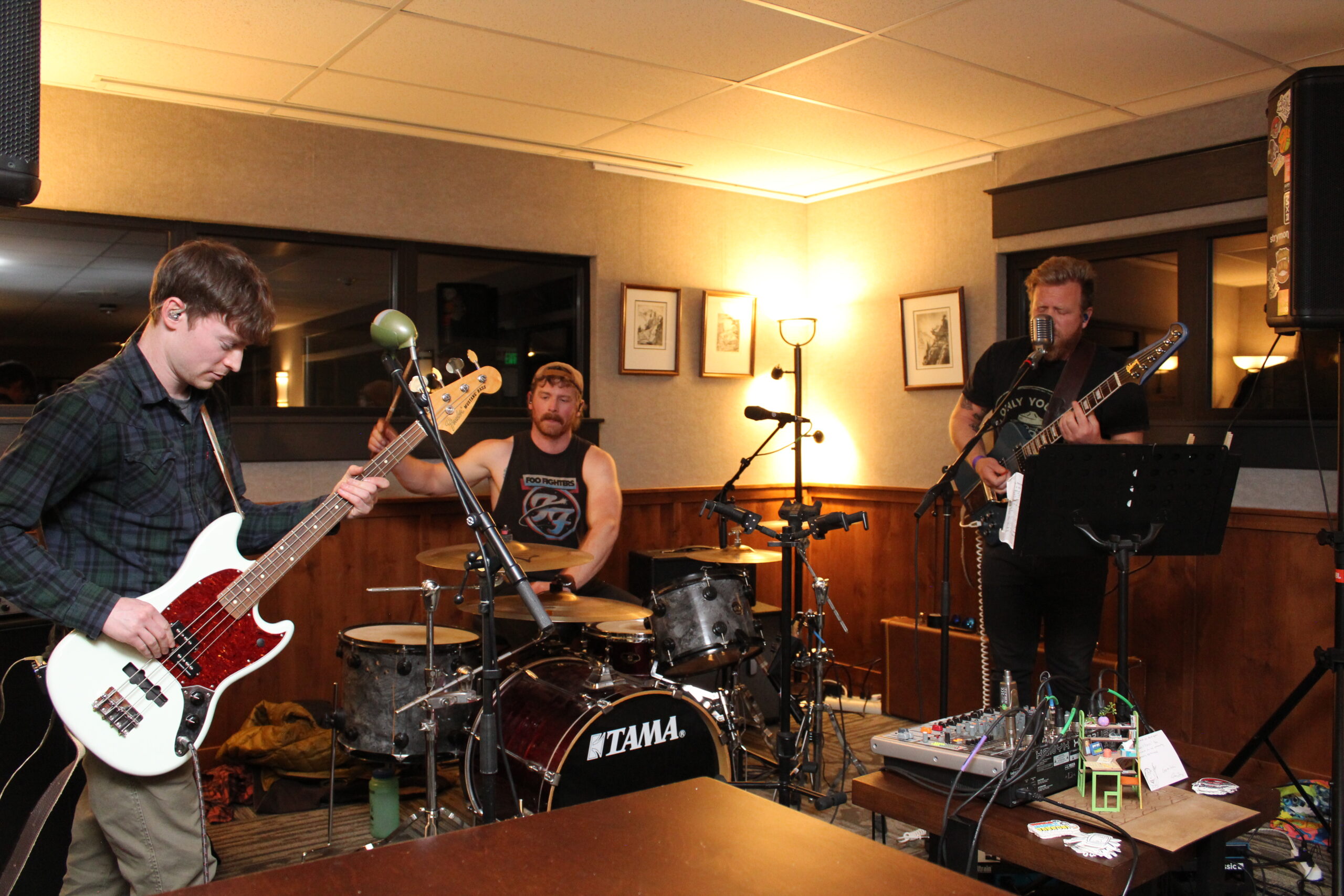
Not only did the juxtaposition of setting up a punk rock band in the quiet room add to the experience, but these library spaces actually created excellent acoustics. Referring to the meeting room we were seated in, Jason explained:
The walls are carpeted and the floor is as well, which helps with the vibrations of sound. So when libraries have this kind of acoustic, it’s like really good for sensitive ears because all of the carpeting is soaking up the vibrations, especially harsh ones. So yeah, the performers really liked it because you could hear each other just a little bit better. . . I remember some people were like, “wow, that’s one of the best they’ve ever sounded.”
While the library may be an ideal place to produce quality sound, hosting six bands in the library is not a simple task. Reflecting back on the event’s largest challenges Shari said:
I’d say just keeping all the logistics in order, making a really solid firm plan as far as like the schedule. . . I made a huge to-do list and made sure everything got checked off. So I think it was just the logistics, making sure we had enough food and enough everything for everybody.
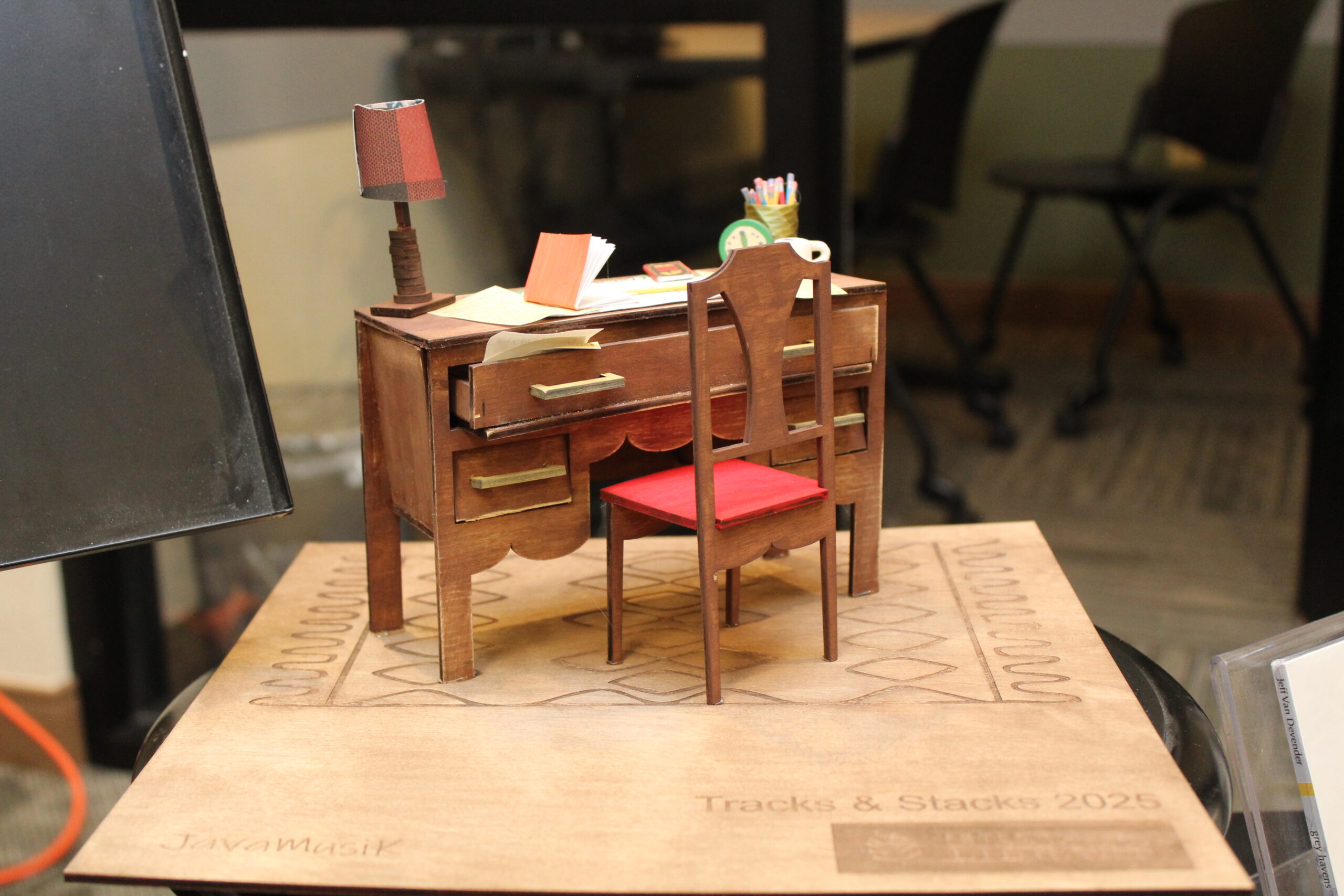
On top of all that, there was the matter of having space for each of the six bands or musicians to perform next to a desk! Shari took care of that, too, using the library’s makerspace to create adorable and incredibly detailed tiny desks for each band or musician to have in their video and take home with them as a memento.
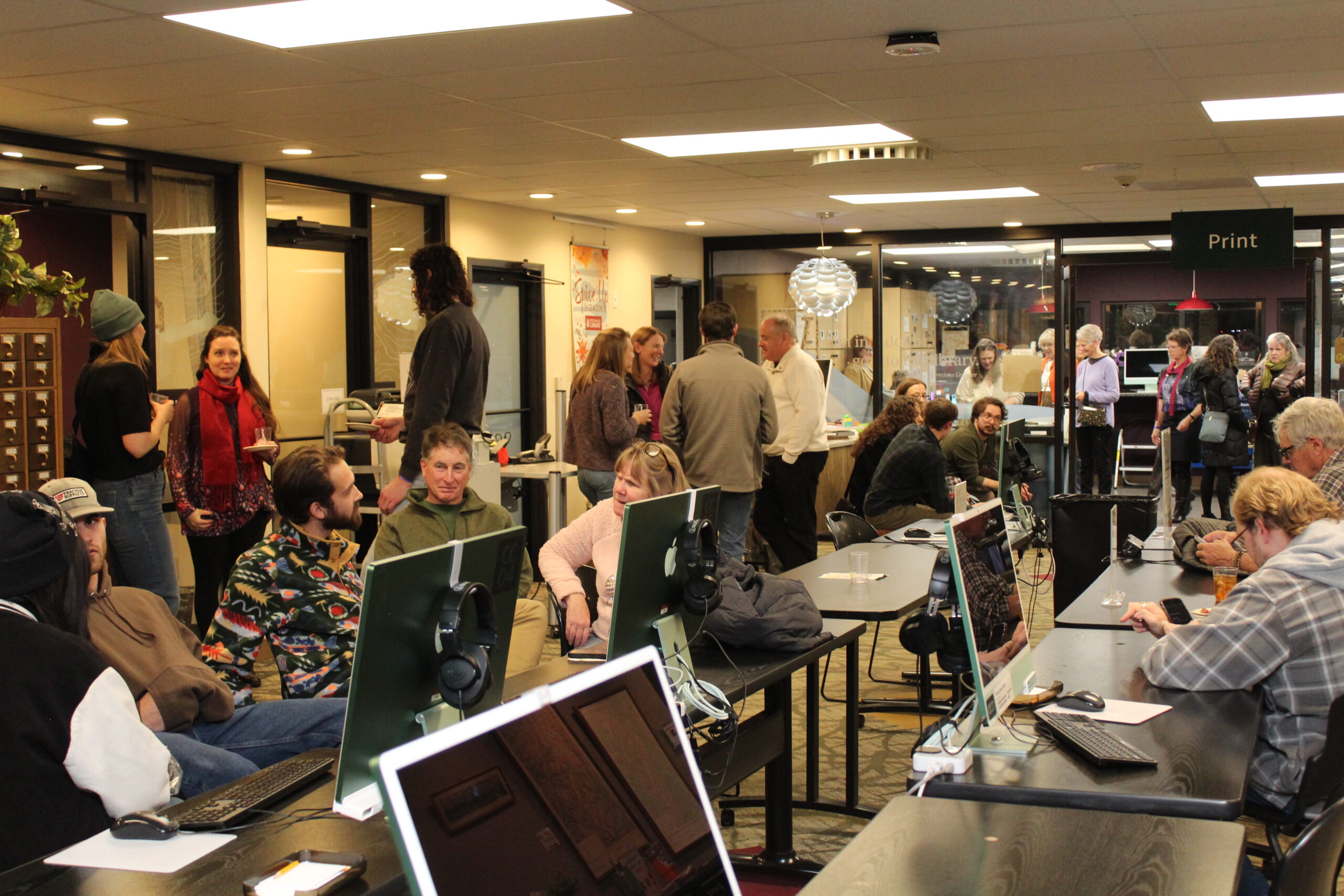
Because Estes Valley Library has two levels, two shows could take place simultaneously, one upstairs and one downstairs. Each band or musician played two short sets throughout the night, which allowed attendees to choose who they would like to listen to or see them all. We spoke with an event attendee who shared how this unique setup added to the atmosphere during the event.
I think the fact that the format was so different was really attractive to people. They could sample lots of different musicians and move around. They’re just not stuck in a chair for an hour or two hours. You can actually move around, mingle. It was pretty casual.
Of course, there were lessons learned and things to adjust for next time, but despite challenges, the seamless execution of the event made an impression on attendees. When describing their initial impression after first hearing about the event, the attendee we spoke with explained, “I thought, ‘Wow, that sounds like just a great creative way to get the community together, and boy, what a lot of work it’s going to be.’” Then, later in our conversation, they shared just how impressed they were “that it all went so smoothly.”
Encore! Encore!
People were so happy. They were so excited and they were so happy. During the event, people were saying how wonderful it was and, “Are you going to do it again? You should do it again.” And even now, people I talked to, three months later, they’re like, “My gosh, that was so much fun.”
Shari reflected on the positive feedback she received during and after the first Tracks & Stacks event which took place in November 2025. In response to the question of whether it will happen again, Shari said, “I think people are going to keep asking us until we do it again.” 2026 is a busy year for Estes Valley Library, as they are undergoing major renovations, but it seems unlikely anyone will forget about Tracks & Stacks in the meantime. Jason even floated the idea of bringing the event to other libraries, explaining:
I have a couple people that have asked me if I was going to bring it to other libraries, like package the idea, gather the data from this year and the next year, and then head down the hill and say, “Hey, this is what we’re doing. Do you want to do it? I can help you out.”
So what exactly about this event has prompted so many requests for another? Each of the three people we spoke to about Tracks & Stacks described it as “fun,” and when asked what the largest success of the event was, the attendee we spoke with stated, “I think it’s just bringing the community together. In times, divided times, bringing people together is always a wonderful success.” Shari explained why she thinks this event brought together so many different people from the community:
The bands we had were so diverse. And so it just brought a diverse crowd of people because they’d come to hear the band they knew, but then they stayed to listen to all the rest of them, too. And so, yeah, people were just excited and happy and bubbly. It was just a fun atmosphere to be in.
When asked what the largest success of the event was from his perspective, Jason also spoke to the importance of it appealing to a diverse audience.
Getting new people into the library. Yeah, having friends admit to me that night, like, “We’ve never been in here, in this place. It’s pretty cool.”. . . I’m like, “Yeah. That’s why I’m doing this event. You’re standing next to the metal detector [for] checkout. Did you know you could check out a metal detector?”. . . . So that was the coolest thing, was getting people back into the library. They just didn’t know of the opportunities and the resources.
Whether people were noticing all that the library has to offer throughout the evening or solely focused on the music performances, there is no doubt that they were having a good time. An event advertised as music in the library, a way to support local musicians, and a community evening of music exceeded expectations by connecting people through a one-of-a-kind experience. “It was joyful,” said the attendee that we spoke with.
Libraries Meeting the Moment
Throughout this Colorful Colorado Libraries blog series, we will be talking to all types of libraries big and small across Colorado. Our goal is to highlight what libraries are doing, have done, and can continue to do well to have a positive impact on those they serve. This could be as small as a meaningful interaction with a patron or a basic service that has a significant impact, to endeavors as large as hosting Tracks & Stacks. Regardless of the topic, at the end of each conversation we ask people, “Today, in 2026, what do you see is the role/responsibility of this library to the communities it serves?” We expect to hear a vast range of perspectives as we talk to both library staff and community members who all have unique relationships to their library. By gathering and sharing these stories and perspectives, our goal is to contribute meaningfully to conversations around the value of libraries in this day and age.
Responses to this question from the three people we spoke with at Estes Valley Library varied, but had the common theme of connecting people to the library or each other. An attendee of Tracks & Stacks shared that it is the responsibility of Estes Valley Library, “To welcome everyone without prejudice, all people of all backgrounds, and to be a place where everyone can come together in our community, to enhance people’s lives and build community.”
Shari, the Technology Arts Librarian at Estes Valley Library, had a similar perspective grounded in the library’s mission statement and pointed to how Tracks & Stacks embodied this mission:
Well, our mission is a connected valley where people and ideas flourish. And I think that is still our responsibility, and our role is to help connect people. And I think that events like Tracks & Stacks did that. I think it did it really well. Even the bands, as diverse as they were, I saw all of the members of all of the bands talking to each other at different times that night. And so even just fostering those connections between artists and between makers and their community, I think is really important. And I think it helps bring the community together. And I think that’s part of our responsibility.
Jason, who had the idea for Tracks & Stacks and approached the library to make it happen, pointed to tangible ways that the library can reach more people by making sure people know what all it has to offer:
I think that the perception that libraries are a place to go for books, I think that perception needs to be crushed this year. Now? Maybe yesterday. Because I maybe get three books a year, but I come here for the makerspace, the 3D printer. There’s so much more to the libraries than just books. So I would say that the 2026 role/responsibility is to prioritize marketing strategies towards the non-readers in the community to utilize all of the library resources available.
When it comes to both connecting people from diverse backgrounds and connecting people to all the library has to offer beyond books, this partnership between the library and a local musician was a huge step in the right direction.
Thank you for reading this chapter of Colorful Colorado Libraries: Stories from our Centennial State. I would like to thank Estes Valley Library and each of our interviewees for sharing their stories as well as Barbara Jo Limmiatis, Community Relations Specialist, for making this story possible. To join the Library Research Service’s Colorado Public Library Data Users Group (DUG) mailing list and receive posts via email, please complete this form.