
A stunning line of jagged peaks comes into view during the drive west across Custer County towards Westcliffe, Colorado. Once you reach the main street of this town brimming with mountain charm, the public library can be found tucked between a shop selling furniture, gifts, and antiques, and a gallery. Amy Bahlenhorst, Research Analyst for Library Research Service, and I had the pleasure of visiting West Custer County Library District and speaking with patrons, partners, and staff of this library. Throughout conversations with seven people, we heard over and over again how the library is adapting to meet community needs and how library staff go out of their way to provide personalized service to patrons. This library visit was filled with inspiration, energy, and insight into how a library can be a cornerstone to those it serves, all of which I hope to share through the stories below.
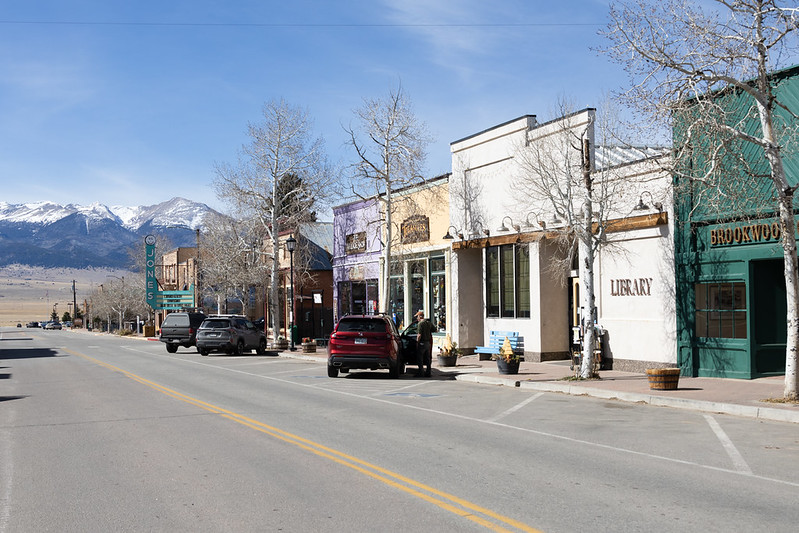
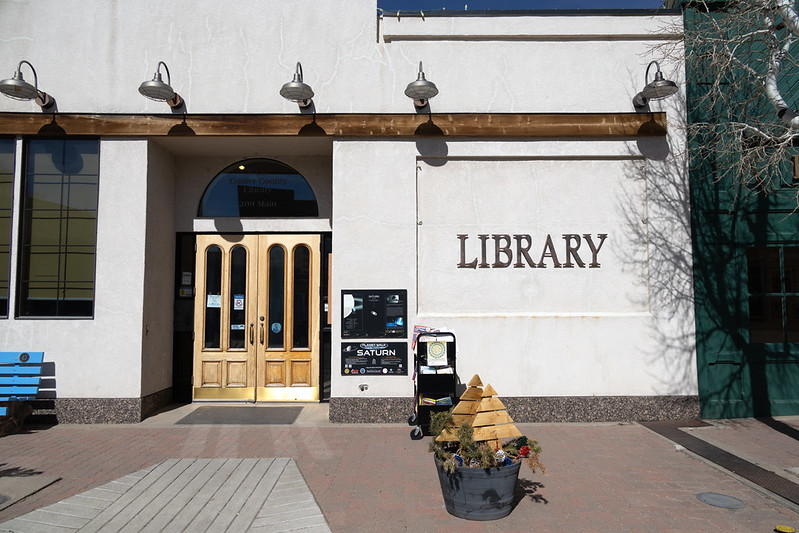
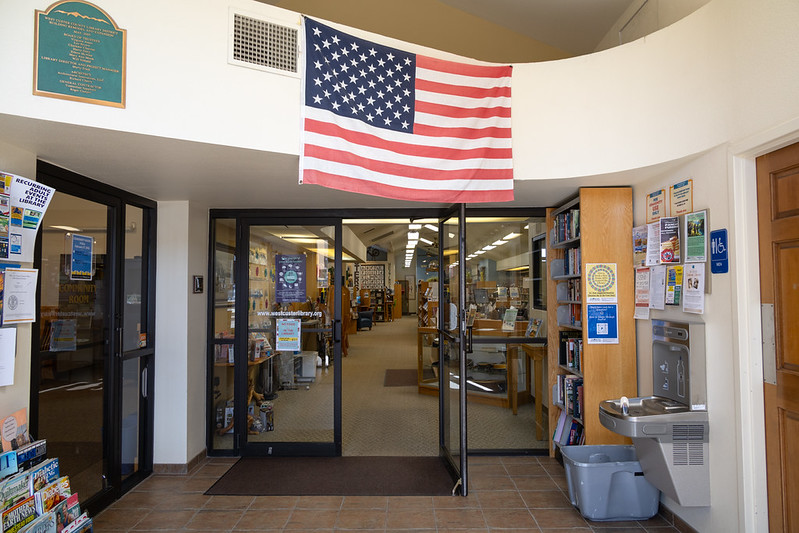
Westcliffe’s main street, where the library is located, and the front of the library.
From Patrons’ Perspectives
The three library patrons we spoke with each started the conversation by praising all that West Custer Library has to offer, and we heard about something unique from each person:
The stuff you can take out, whether it’s snowshoes or, I’m in need of a sewing machine right now, so I have to be loaning that. . . And here we are, this little teeny tiny town. And they’ve got, let’s see, they have Starlink here at the library and printing capabilities and everything from workshops on, there was one on making sourdough bread, making your own yogurt, all sorts of loosely quoted homestead things in addition to legal resources. Not to represent somebody, but guidance.
~anonymous library patron
I use the library for a whole lot of things. I think interlibrary loan tends to be one of my top favorites as a homeschool mom and somebody that likes diverse resources. So I think I use interlibrary loan a lot. But other services that I use, I mean, I check out snowshoes. We’ve checked out metal detectors. We go to the community programs. We use the privacy booth. My son’s really into Colorado history. We’ve used that section in the library. So really all of it. . . The community events are fun, the puzzle competitions or the reading challenges and all of that. So I think I use everything.
~Angela Pasquith, library patron
I’m a very, very avid reader, or used to be when I could see. And I would check out five, six books at a time and run through them in the two weeks. . . The library here has a wide selection of a lot of different authors. They have a lot of local books, history of the valley. So I try to utilize that as much as possible. Now that I can’t see, I rely on talking books, and they have a good selection of them here also on CD.
~Russ Johnson, library patron
It is not lost on patrons that West Custer Library has limited financial resources, but that only makes the impact of what they have that much more special. “And this library in particular, it’s not like there’s a lot of tremendous resources here. They don’t have this huge influx of funding, but the way they steward what they’ve got is really extraordinary,” said one library patron.
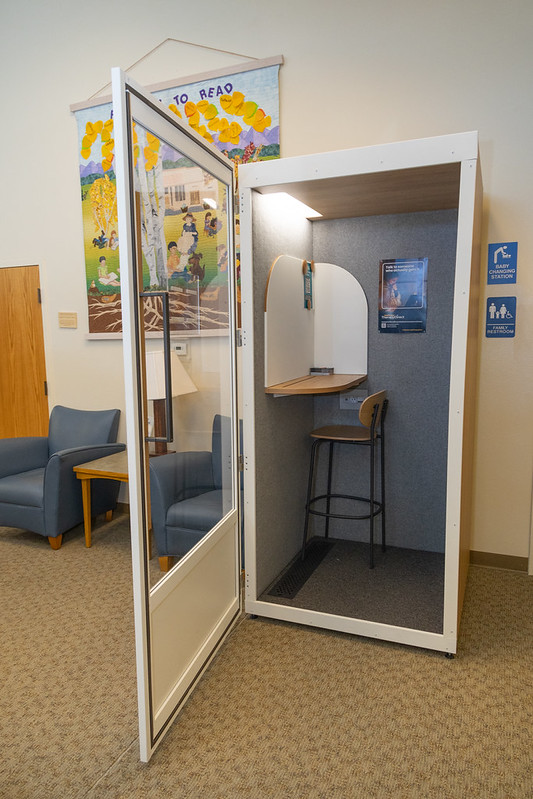
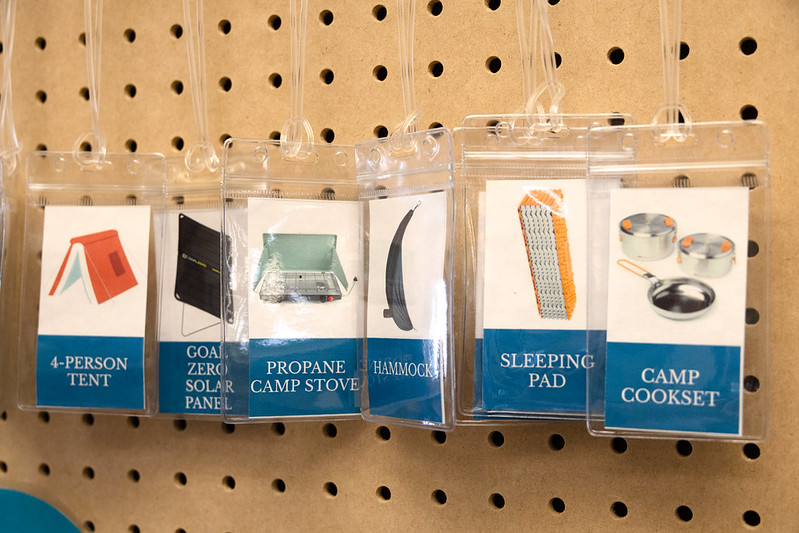
West Custer Library’s privacy booth and items available for checkout in the library of things.
However, it is not easy for everyone to get to the library to check out all that it offers. West Custer Library’s service area is rural, public transportation is nonexistent, and the majority of people do not live in town. This barrier to library access is something that West Custer Library’s Co-Director Janet Rhodes has been actively trying to address. The library received a $20,000 grant from the American Library Association (ALA) to help with transportation which is being used to implement a home delivery program (Library to Go-Go) and Rotary van transportation services.
When we spoke with library patrons about their experiences with these services, it was immediately clear that there is more to them than one might expect:
Somebody showed up at my house and they’ve got these, they’re bigger than laundry baskets, these huge boxes of books based on the type of interests I have. And then we can spend time going through what appeals to me most and when I want to read them and sort of schedule it out. It’s waving a magic wand. It’s the next best thing.
~anonymous library patron
. . . when I can’t get a ride in, they have a Rotary van service here in town that will come out and bring me in to participate in the different things they have going on. And that’s at no cost to me. So, they reach out to me every month and tell me the things that are going on and see what I would be interested in. And then I can call and schedule a ride or put it in my calendar to come and participate. And I find that’s really helpful because otherwise I’d have no way of knowing what’s going on. They’re very, very proactive in reaching out and getting participation in different programs, and I love it. They just take really good care of me.
~Russ Johnson, library patron
Later in our conversation with library patron Russ Johnson, he explained that “[The library staff] are very personable and, you know, you don’t get that nowadays. Customer service is a thing of the past in most places and they go above and beyond here, no doubt.”
But as our conversations progressed it also became clear that this library offers something even beyond personalized service and access to its diverse collections. Much of the library’s power lies in its ability to connect people and bring people together to support each other. For example, when discussing the Founder’s Constitution class that he attends weekly, Russ explained what he would miss if the class didn’t exist:
So I would really miss that camaraderie of my classmates because we’ve all kind of bonded together. And most every activity that I do here at the library is with a group and most generally [it] is very open, very helpful. It seems like folks here get along pretty good. And I would miss that if that wasn’t available.
~Russ Johnson, library patron
In fact, each of the three patrons we talked to described the library as a place people can find community. When asked if they would like to share a memorable or impactful experience related to the library, one library patron recalled talking to people who have participated in a grief support group or a veterans group at the library and explained, “It services the entire community. I can’t think of anybody that’s left out.” Later in their response, they went on to say, “They’re really the community center here. We don’t have one. . . I bet more people congregate here than anywhere else.” In response to this same question, another library patron explained how the library also provides community support through the kits that it loans out:
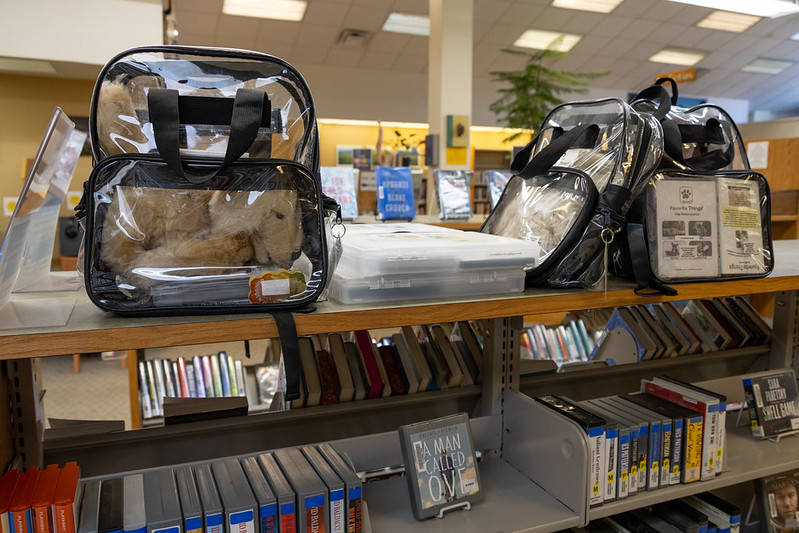
I think it’s just how it fits within the community. . . I think one of the things that touched my heart the most as far as materials that you could check out was the one, I forget what they’re called, but they help with people that are struggling with memory issues. Those little kits with the stuffed animal in there that they can pet. And I haven’t necessarily used those personally, but I think that sticks out in my mind as how our community supports each other throughout the stages of life.
~Angela Pasquith, library patron
It is incredibly important for West Custer Library to reach people of all ages. The county it serves has a higher median age than anywhere else in Colorado, but, at the same time, they have seen an increase in young families in recent years. According to the patrons we talked to, West Custer Library is on the right path. When asked what West Custer Library’s role or responsibility is to those that it serves in 2026, our interviewees didn’t ask for more than what the library is already doing:
I think they do a fabulous job, so I think it’s keep on keeping on doing what they need to do. I mean, they’re so fabulous at engaging the community and really reaching out to figure out what everyone needs, and how do we accommodate that? I think they really go above and beyond any expectations I could possibly set forth with that.
~Angela Pasquith, library patron
I think that with the expansion of our community… our community is growing quite a bit… I think that they’re able to, this library, able to expand with the times. I think that the services they offer to the community is just, to me, it’s amazing. . . And I think that they’ll continue because of the type of people that work here. I think they make the library the library. I mean, they just go out of their way all the time. And I see that continuing. And I think as a community grows, I think the library will grow. And I hope that the staff are up for that, so that they can keep offering the same wonderful service that they do.
~Russ Johnson, library patron
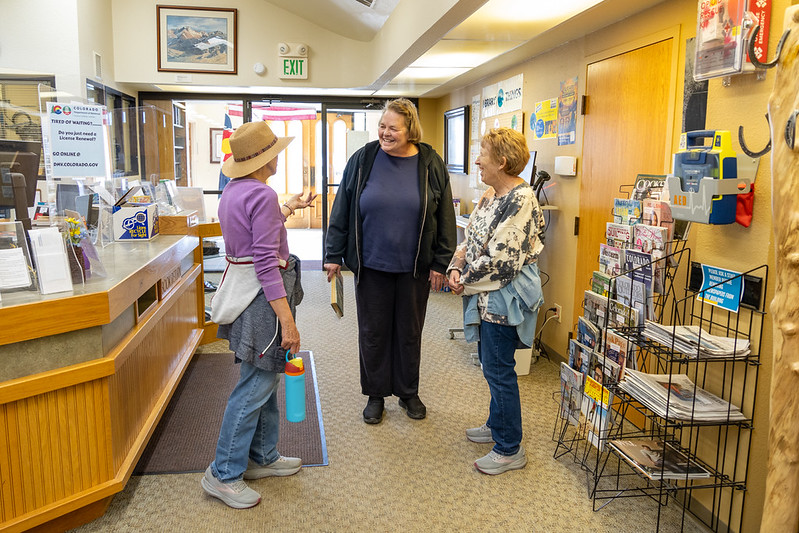
So how has West Custer managed to make such a positive impact with limited resources? We also learned how the library’s partnerships and collaborations throughout the community make all the difference. “The library is more networked within the community than any other organization,” said one patron. “It’s kind of the heart, the lifeblood of this community.”
Hearing from Library Partners
Library staff shared a long list of community partners that West Custer Library is working with, and we were lucky to meet two people from one such organization – Heidi Lambert and Michael Hayes from High Mountain Hay Fever Festival Association. While applying for a grant several years ago they came up with potential ways to expand their initiatives, such as providing a musical instrument lending library. While they didn’t receive the grant they were originally applying for, they still saw an opportunity to pursue the idea. High Mountain Hay Fever had the funds, and the library had the space and know-how to make it happen. This partnership has formed the Hayseeds Instrument Library.
High Mountain Hay Fever is a local, volunteer, non-profit organization that runs an annual bluegrass festival and has donated one million dollars to local children’s health services. But Heidi and Michael also wanted to help local youth by connecting them to music. There is a children’s music program at the festival called the Hayseeds, but Michael noticed barriers that prevent local participation:
We recognize that at the festival, a lot of the kids that were in the Hayseeds were children of attendees at the festival, not kids from the community. And thinking about what kind of barriers they might have, including access to instruments and the costs that are associated with that, was part of the genesis of the idea as well.
Michael also explained how open communication with the library laid the foundation for a strong, successful partnership:
I love the library and the librarians. It’s been a really nice partnership. I feel like there’s been lots of idea exchange back and forth. . . We don’t know like lending and all that whole process. And so we had great meetings early on just like, “Well, is this a fit for you? Is it a fit for us?” And here they already had some of that library of things that they were checking out. And so this in some ways fit with that. But they’re a little different than just like checking out snowshoes or a sled. . . [We asked] “What kind of goals do we want to set? How will we know if it’s working? How often should we be checking in with each other?” And it’s, yeah, I think it’s gone pretty amazingly.
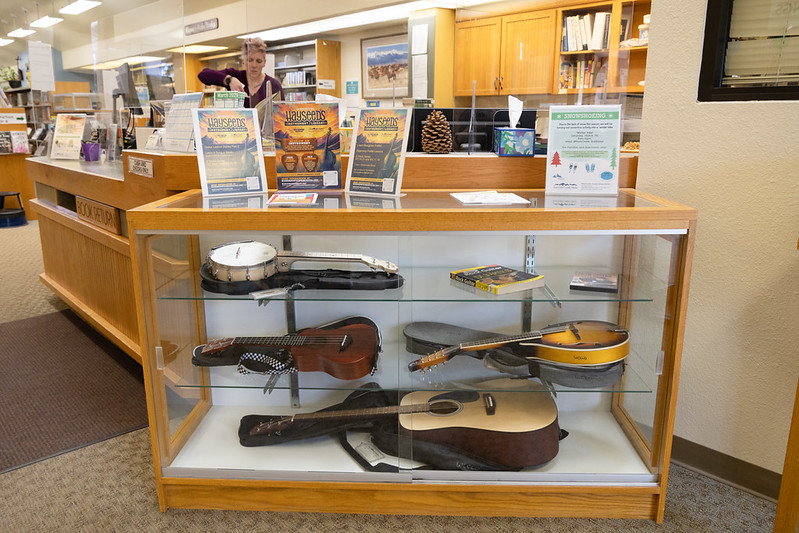
The Hayseeds Instrument Library was just the start of all that Heidi and Michael are now offering at the library. Heidi explained that free, optional music classes or individual lessons are an important part of the service:
We wanted to make sure that they just didn’t check out [an instrument] and then get frustrated. So we really want to move this, move the needle forward and then have more people playing music because it is such a strong brain health instrument.
These incredible services are also a great example of how West Custer Library is bringing in and connecting people of all ages in the community:
The other part of it that I really love is the multi-generational, the multi-age thing. You see like in the bluegrass jam, when you’ve got a seven-year-old, [and] her partner, who’s 80, and a bluegrass legend, is playing right along with them and encouraging them, and they just light up.
~Michael Hayes
Heidi and Michael explained how learning an instrument is a healthy mental exercise, and they see people’s confidence grow significantly as they learn new skills and play with others. For the guitar class they are currently teaching at the library, it is also a way to socialize:
And the guitar class, it is mostly adults. And some of them are new folks in the community. . . And some have been here a very long time. And so I did not anticipate it being a really important social gathering. . . I was a little worried [because] the guitar class was so big. I was worried, is it going to succeed? And I realized, it doesn’t matter. They’re having such a good time.
~Heidi Lambert
When asked what they see as the role or responsibility of this library to those that it serves, the Rotary van transportation service was one of the first things that Heidi thought of:
[The library] is incredibly important. I mean, the van service. . . High Mountain Hay Fever uses that and we donate, we support them financially. It is because of the divide between the haves and the have-nots here. There is a huge need for a service like that, and that the library gets involved in those types of endeavors is amazing.
Later in her response, she went on to say –
It has been a powerful library for a very long time. It’s been through all kinds of ups and downs, and it’s been just so important. And it’s not an easy community. There’s some turmoil in the community, but the library is just a constant. It’s a constant.
Stories from Staff
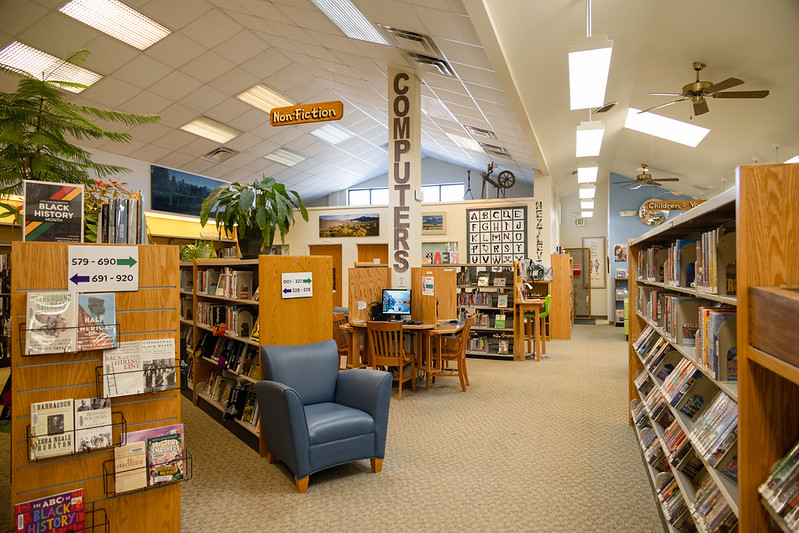
During our time at West Custer Library, Amy and I also spoke with two staff members: Mindy Kenyon, Youth Services Coordinator, and Janet Rhodes, Administrative Co-Director. They had so many wonderful stories to tell about their time working at West Custer Library, but what stood out through them all was their commitment to bringing people together to learn and grow.
“Most of my job is outreach and getting out there and seeing people,” explained Mindy. But she also told us how organizations throughout the community are often initiating conversations with the library to collaborate on programs or projects. Oftentimes people want to work with the library to help get the word out about an event or opportunity. “We’re kind of a community hub for a lot of stuff, and especially an information hub,” Mindy explained. “A lot of times we co-sponsor, to spread the word.”
Mindy also described that, as more children join the community, she’s seen an increase in children’s activities organized, which allows the library more opportunities for partnership rather than being the sole entity offering programming. The large homeschooling community in the area has organized their own events but still depends on the library for resources. Mindy, who also homeschools her children, sees a gap in communications when it comes to events and resources for homeschooled children and hopes to address it.
Sometimes it feels like it’s daunting and overwhelming for homeschoolers because they’re just like, “We want to participate, but we don’t hear it in time. We can’t plan for it.” So what I’m trying to do is bring together possibly a resource fair. . . The idea is to bring these particular different homeschool programs, enrichment programs, together to kind of talk about what they provide, what they do, and then also see if we can do a homeschool curriculum swap, resource swap, something that provides easier access to materials, to resources, because I would say homeschoolers are our main source of circulation for our children’s youth [materials].
The Dungeons and Dragons club is another great example of how West Custer Library is supporting its youth and giving them a safe space to thrive. Mindy shared how she noticed younger kids interested in learning to play and so started a D&D club for beginners. And kids are learning a lot more than just how to play the game by participating:
They’re looking for connection. . . It’s creative enough to where the kids have agency over something that they may not feel like they have agency over, right? They’re socializing, but they’re also engaging their brains in storytelling. It’s a storytelling type of game experience. And a lot of times when you break it down for them, you are learning all of these basic literacy skills within the context of a game.
As we continued to talk about the benefits of this activity, Mindy added, “I think it’s a place to be seen and be accepted, for sure.”
When asked how she would like to see West Custer Library grow and expand, Mindy responded, “For me, my personal goal within this particular job is to bring people together.” Finding common ground in a time when people are divided politically is crucial. “We all share the same goals of wanting to provide something great for our children or for your kids,” Mindy pointed out.
Janet also spoke of bringing people together by finding common ground during our conversation with her:
Oftentimes for us, I think it’s presenting programs and just allowing people to come. And they’re not actually talking about, “Well, I disagree with you on this and on that.” You know, it’s not direct and confrontative, but we can all be friends together when we go up and want to fish at one of the alpine lakes, because everybody likes to do that. It doesn’t matter what color your politics are. So those kinds of things give opportunities for people to mix together. So are we a social club? Kind of.
As Administrative Co-Director, Janet spends a lot of time working on the computer behind the scenes, but she also works hard to make sure the library is seen. “I also feel pretty strongly about promoting the library within the community,” she explained to us. “I was new in the community myself, so getting out has been good for me. Going to town board meetings and meeting with the commissioners and just finding out how the government piece of things works.”
Janet also gave us some insight into how the library manages to reach as many people as it does. When asked how she has seen the library evolve since she started in this role shortly after the pandemic, she pointed to improvements in their marketing strategies including the implementation of LibraryAware to distribute their newsletter:
We put in a marketing program. . . LibraryAware is a little more expensive, but it’s integrated into an e-mail list. So we are able to send out directly e-mail newsletters. We were able to create flyers. . . And I think people have become more aware of us as we’ve learned how to promote. And using that, it’s been a really valuable tool. . . So it’s a really pretty good solution for us.
From West Custer Library’s patrons, partners, and staff we learned how, when the library reaches people (by either bringing them into the library or bringing library services to them), it opens doors. Some people visit to connect and find community, others want to be “transported by a book to a whole other place and time,” and some need the quiet space provided by the privacy booth. Janet summed all of this up well when we asked her what she sees as the role or responsibility of West Custer Library to those that it serves in 2026:
I think it’s to offer those connections to lifelong learning for all ages and to encourage curiosity… encourage curiosity and finding out stuff. . . I really feel strongly that we’re here to build bridges among people, to encourage that kind of an open discussion in a civil manner. . . I just think there’s a lot to be learned from everybody.
Thank you for reading this chapter of Colorful Colorado Libraries: Stories from our Centennial State. A huge thank you goes to West Custer County Library District, each of our interviewees for sharing their stories, and Valerie Mosley, CDE Multimedia Manager, for the photos. To join the Library Research Service’s Colorado Public Library Data Users Group (DUG) mailing list and receive posts via email, please complete this form.