
Ron Schermacher, the Idea Lab Educator at Ignacio Community Library in southwest Colorado, was once a regular library user who would check out books about local history from the library. He admits that, before working at the library, he held the common misperception about library work that there would be time for reading on the job. But after stepping into a role as Library Assistant, it didn’t take long for Ron to change his view and understand the full magnitude of what library staff do and all libraries offer. In his time working at Ignacio Community Library, he has expanded its services in truly impressive ways. Ron still spends part of his time working as a library assistant as well as planning programs, creating take-and-make kits, adding to the Library of Things collection and coordinating volunteers and interns. But growing and managing the Idea Lab is at the heart of all his work. Ignacio Community Library’s Idea Lab is a tinkerer’s paradise. Ron is continually adding to the materials available, learning about the machines, keeping them serviced, and helping people use them. He lights up when given a chance to explain what each machine does. Although he clearly loves every tool available, Ron also told us, “It’s not about the machines themselves, it’s about the deeper learning behind the machines that they can provide.”
Building a Sustainable System
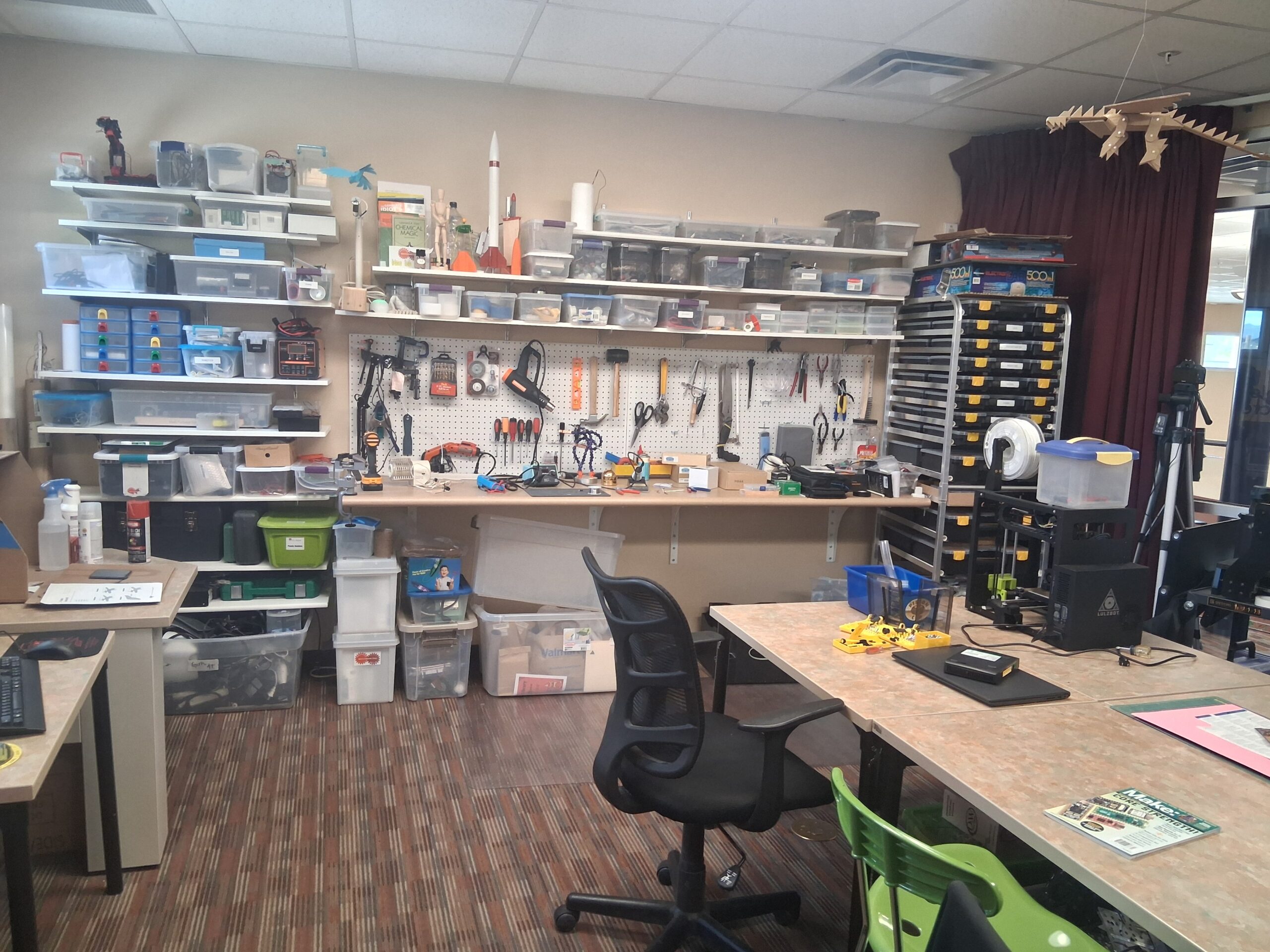
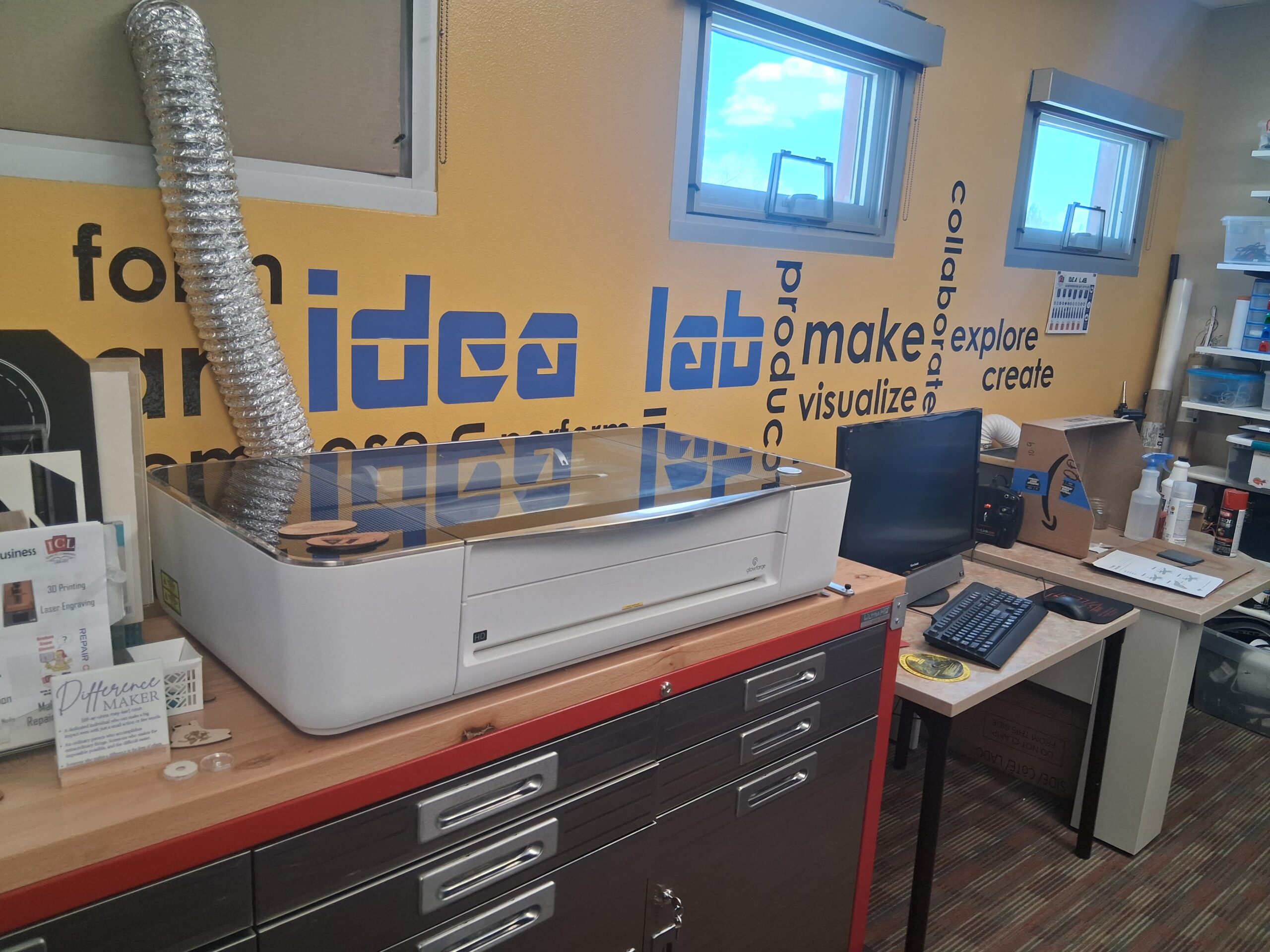
Ignacio Community Library’s Idea Lab is such an impressive space with so much to offer that it immediately begs the question: How does the library sustain all these services and materials? There are three 3D printers, a Glowforge laser engraver, a Cricut cutting machine, cameras, a radio-controlled model plane flight simulator, an Elgato VHS to digital media converter, soldering equipment, and so much more. In just the few hours that Amy Bahlenhorst, Research Analyst, Polly Gallagher, Public Library Leadership Senior Consultant, and I were visiting, we were introduced to a myriad of projects of which I’m (unfortunately) only able to describe a select few in the space below. That being said, Ron wants to inspire libraries to build makerspaces, and he made a point to tell us that it’s smart to start small and coordinate with resources that already exist in your community.
It doesn’t have to be big. It can be small. Some libraries, all they do is podcasting. They just do video and audio. And that would probably be more sensible, especially if you were in a big area that [already] had a bunch of makerspaces. Like then you could coordinate more and choose what people wanted to focus on.
In Ignacio there are no similar makerspaces for public use, so the library is the place to go. With Ron’s dedication and curation, the Idea Lab has evolved from a few shelved bins to the substantial workspace it is today.
Finding Funding
There are no additional costs for patrons to use the Idea Lab or its materials. “They’ve already paid for it,” Ron explained, referring to the district mill levy that provides much of Ignacio Community Library’s funds. However, as the Idea Lab has grown there have been additional costs to keeping materials stocked and equipment maintained, so we asked Ron how he covers these and heard how it is largely sustained through donations and grants.
Ignacio Community Library accepts book donations and sells any donations that they decide not to keep in their collection. On the library’s second level there is a book sale section, and books selling for over $25 dollars are also listed on Amazon. Ron also uses platforms such as BooksRun and Dream Books Co., and sells old library equipment that Ignacio is no longer using on eBay. Accepting donations is a lot of work, but Ron has a system in place that makes it cost effective for Ignacio Community Library. He also pursues grants for improvements to the makerspace and researches affordable solutions for any upgrades needed. For example, he explained how he plans to remove the Idea Lab’s old carpet but was first quoted $17,000 for new flooring. His revised plan involves refurbishing the floor beneath the carpet himself and laying down rubber mats bringing the total project cost down to $800.
Ron’s successful handling of donations allows him to also accept many materials beyond books, including e-waste. Without another e-waste recycling program in town, this is a need in the community that the library now fills. Some of the e-waste contains parts that can be used in makerspace projects. Additionally, Ron runs a program where students can deconstruct electronics that were donated as e-waste to learn about their inner workings without worrying about putting them back together. Ron properly disposes of any e-waste that does not find a home in the Idea Lab at the out-of-town facilities that accept it or passes along parts to partners with a use for them, such as the Bayfield High School Robotics Club.
Not all libraries have the capacity to handle donations at this level, but thanks to Ron’s commitment and ingenuity, it has worked for Ignacio Community Library. Being so accepting of donations also brings in people who want to donate some awesome additions to the Idea Lab or the Library of Things available for checkout, such as an electronic lab kit, which helps these collections grow.
Organization and Consolidation
Ron also took on a large organization project of the library’s storage spaces and in doing so, found valuable materials and equipment that the library already had tucked away:
That’s how the Library of Things started for us here. It was quite organic and that’s why it was such a mess about a year ago and needed to kind of totally be redone . . . one of the things I always felt I was kind of good at was just organizing and the director we had at that time . . . she actually had me come in on some days just to clean out closets and so I would take the back closet and pull everything out. . . just consolidating things and getting it in the same places.
Throughout this process Ron inventoried, labeled, and grouped like items, some of which became part of the Library of Things or take-and-make kits. Now, patrons can browse the Library of Things online or by looking through cards on display at the front of the library. This organization has also helped library staff know what is already available to them and prevented the purchase of duplicate materials.
With everything Ron has acquired and all the projects taken on in the Idea Lab, the space is bursting with machines and materials. When asked what his vision for the Idea Lab is in the next few years – how he would like to see it grow and evolve – Ron said that currently they are “offering everything.” Moving forward he would like to be a bit more selective. “Pick the programs that have been the most successful, the machines that are the most useful, and in the next couple of years, maybe get rid of some of the extra,” Ron explained. One of the things he will consider during this process is whether the opportunity already exists for community members outside of the library. For example, the CNC router in the Idea Lab isn’t used much, likely because a larger one is available at the town’s high school. This also aligns with the advice Ron gives libraries just starting to develop a makerspace: Consider what the community already has and where there are gaps the library can fill.
As we learned how Ron built and sustains the Idea Lab, what stood out was his resourcefulness and the amount of time he dedicates to this work. There is no doubt that the position keeps him busy, and he wants to help library leadership beyond his library understand what his role entails and how it benefits communities:
On Library Makers [forum]. . . one of the goals of that group is to advocate for our position, because we’re under the impression that most of the directors really have no idea what we’re doing, in the details. They know broadly what we’re doing, but they don’t understand how much time it takes. And most of the small makerspace librarians are in the same position I’m in where they’re doing multiple things.
On top of finding funding (whether through managing donation sales or grant writing) and maintaining the space and materials, there’s arguably the most important element of his work – facilitating programs and learning. Currently, Ron runs programs in the IdeaLab on Fridays and Saturdays. During these times any number of people might show up, and he could be helping a regular user continuing work on a long-running project or a brand new student wanting to use the 3D printer for the first time. No matter what the day brings, Ron strives to accommodate everyone and create accessible experiences that encourage continued learning.
Projects Unlocking Potential
What brought the most color to our visit was hearing the stories of learning Ron shared from years of working with patrons and seeing firsthand some of their awesome creations. Ron has a particular knack for engaging students who might struggle in a traditional classroom setting. When asked if he has a favorite memory from working in the Idea Lab, Ron shared the story of a boy in ninth grade who was drawn to an electronics kit. During their first few sessions this student told Ron that he could not read or write, so Ron would help him through the instructional booklet that came with the kit. However Ron shared how this changed:
Fourth or fifth time we’re doing this he looks at me and he goes, “Actually, I can read or write. I just don’t like to.” And I said, “Well that, my friend, is a totally different situation. You were reading this. You can do this by yourself.” And he did. And after that, he actually started checking out adult nonfiction, mostly animal identification books. . . through working on electronics together, he actually gained a love of reading and [had been] telling people that he couldn’t read or write, even though he knew how to.
Ron went on to share that years later, this former student stopped by the library to say hi while visiting the area. “He was just so happy to come back, when he was visiting, to the library, because it was just such a great place to have.”
Problem Solving at Any Age
Students of all experience levels can take away important lessons from their time in the Idea Lab. When asked how the Idea Lab benefits its users, Ron pointed to the increased spatial awareness skills he has seen younger students develop and lessons in design and project planning. At first, Ron carefully planned and tested each project beforehand to limit unforeseen challenges, but he quickly saw that much of the students’ fun and learning took place when they got to troubleshoot these problems themselves. For example, Ron showed us a pumped storage hydropower model that Idea Lab students built last year and outlined the collaborative process of building it. When the model’s valves weren’t working properly it was a student who found the problem and developed a solution.
One of Ron’s favorite lessons to teach is building and launching model rockets. After any successful rocket launch, a natural question for students to ask is, “How high did that go?” This inevitably leads to a math lesson that students are eager to learn. It’s trigonometry, but “you don’t call it that,” Ron clarified, showing how he reframes topics to make them more accessible to his students.
Of course, the Idea Lab is not just for young learners. Ron also told us about working with adults:
I have one adult who comes regularly to the electronics hour, and we’re teaching ourselves how to do electronics. This is one of those classes where we started with this book, and now we’re into the third edition. . . And she also is in the sewing group. . . And now she’s starting to get into electronic sewing, where you put the electronics in the clothing. . . [or] Electronic jewelry.
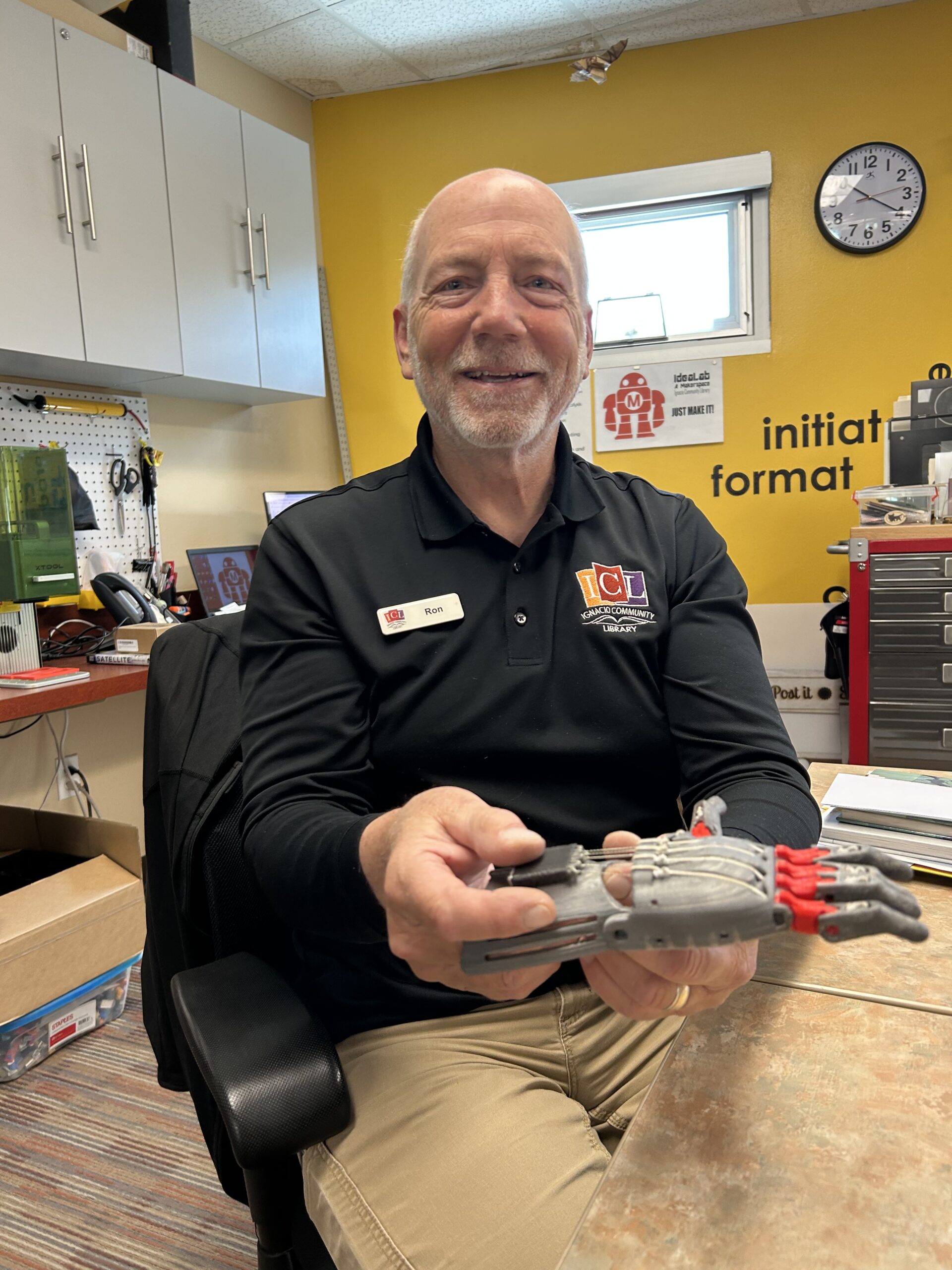
Adults use the Idea Lab to learn new skills, find new hobbies, or even grow their careers. Ron said that a school teacher who worked on many STEM projects in the Idea Lab over the summer moved into a new position as a STEM teacher after gaining this experience. Additionally, 3D printing is transforming many professional fields and makerspaces can help people get ahead of the curve. As an example, Ron showed us a child’s prosthetic hand that was 3D printed in the Idea Lab and explained how 3D printing technologies are expanding access to prosthetics.
Ignacio Community Library staff are also using the Idea Lab to learn new skills and even create materials for programs. All staff members are encouraged to learn at least one machine of their choice in the Idea Lab so they are comfortable teaching others how to use it. “It expands their comfort zone and increases their knowledge. And they’re always kind of amazed to see the things that are coming out of here, too. So it’s an educational process for everybody,” Ron told us.
Separate from the Idea Lab, the library also hosts the Repair Cafe – a regular library program where people bring in broken things to be fixed. The volunteers running the Repair Cafe have helped people fix all sorts of things, such as bikes and electronics. And anyone bringing in an item is involved in the process, so they can learn how to repair it themselves. From both the Repair Cafe and the Idea Lab people gain problem solving skills they can apply to all sorts of real-world scenarios moving forward. Instead of overwhelming people with policies and rules as soon as they step into the Idea Lab, Ron gives people the space and freedom to try something new and make mistakes. He’s always happy to lend a helping hand, but he’s found that letting students lead the way and make their own decisions encourages creativity and participation.
A Creative Space for All
Before working at Ignacio Community Library Ron was a river rafting guide, and it’s clear to see how the skills he acquired in this line of work (managing people and helping them through challenges) apply to his work in the Idea Lab. Ron believes that there is something in the Idea Lab for everyone, but sometimes it takes people skills and a little intuition to know what might draw people in. It was clear throughout our conversation that he also has a special talent for meeting everyone right where they are at in their makerspace education while fostering their creativity and problem-solving skills along the way.
Though our visit was focused on the Idea Lab, we also had the opportunity to see different ways community members are engaging with the library. In the meeting room where Ron showed us the aforementioned pumped storage hydropower model, we had the pleasure of chatting with an art group that gathers in the library to socialize and paint. Members expressed their love for the library, and one explained that it is a place where they can laugh and make noise. The positive energy and creativity coming from this group was contagious.
As with all Colorful Colorado Library interviews, we wrapped up our conversation by asking Ron what he sees as the role/responsibility of his library, to which Ron responded by referring to the library’s mission statement: “It’s a center to bring people and ideas together for growth and education. That’s our mission statement. The center for bringing people and ideas together. . . for learning and personal growth. I think that’s the exact thing,” he stated. Ron works hard to ensure that no one is left out of this mission by creating a welcoming space that empowers people to learn in the ways that work best for them and take their education into their own hands. Ron described a recent conversation which exemplifies his approach:
[A] guy just the other day – “You have such cool equipment in here.” And I looked at him, and I said, “No, you have such cool equipment in here. . . this is not my equipment. This is your equipment, you know. I’m just here to facilitate it.”
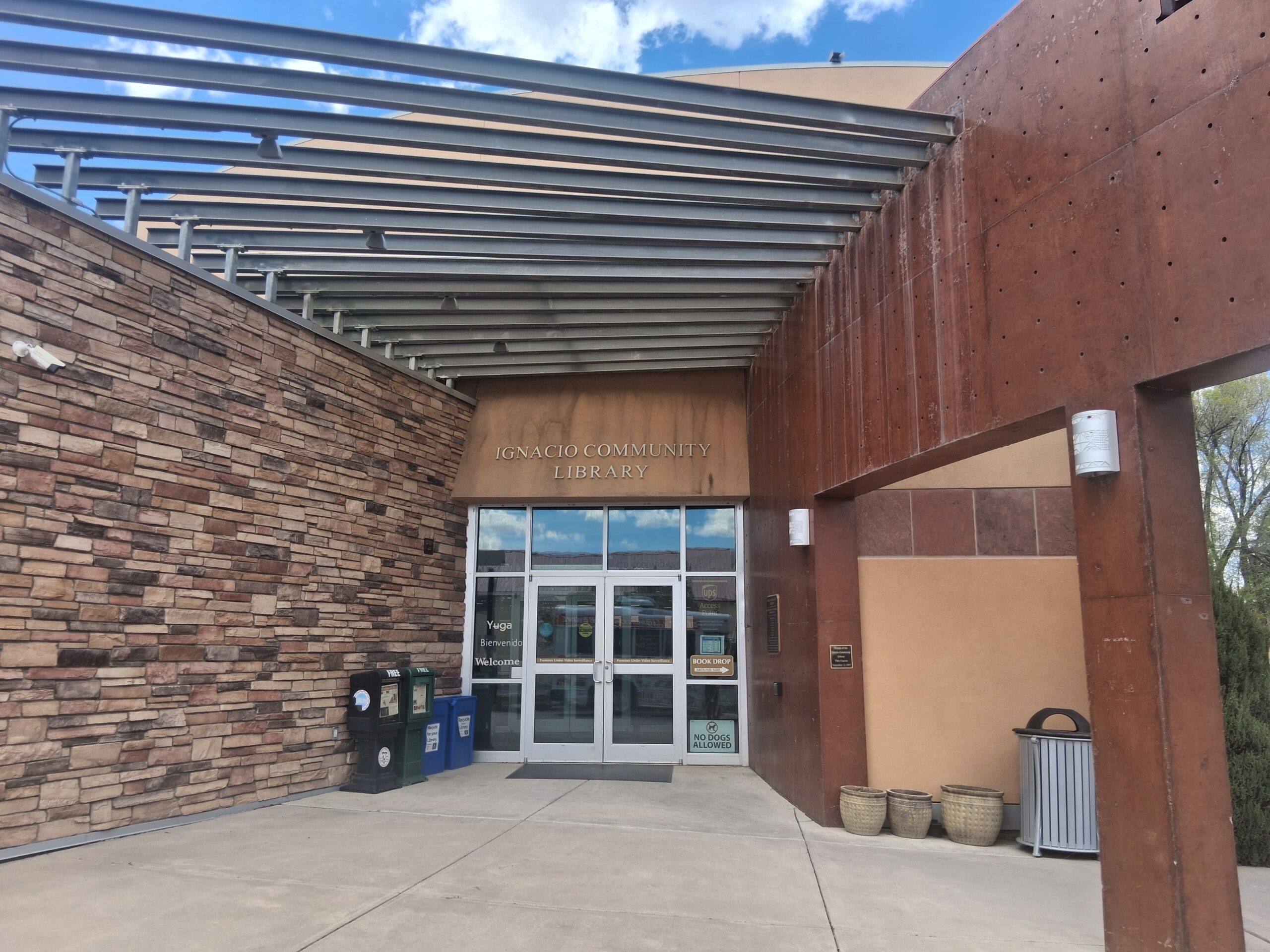
Thank you for reading this chapter of Colorful Colorado Libraries: Stories from our Centennial State. A huge thank you goes to Ignacio Community Library and Ron Schermacher for hosting us. To join the Library Research Service’s Colorado Public Library Data Users Group (DUG) mailing list and receive posts via email, please complete this form.
If you would like your library to be featured in a post please reach out to Sara Wicen at wicen_s@cde.state.co.us. Thank you!